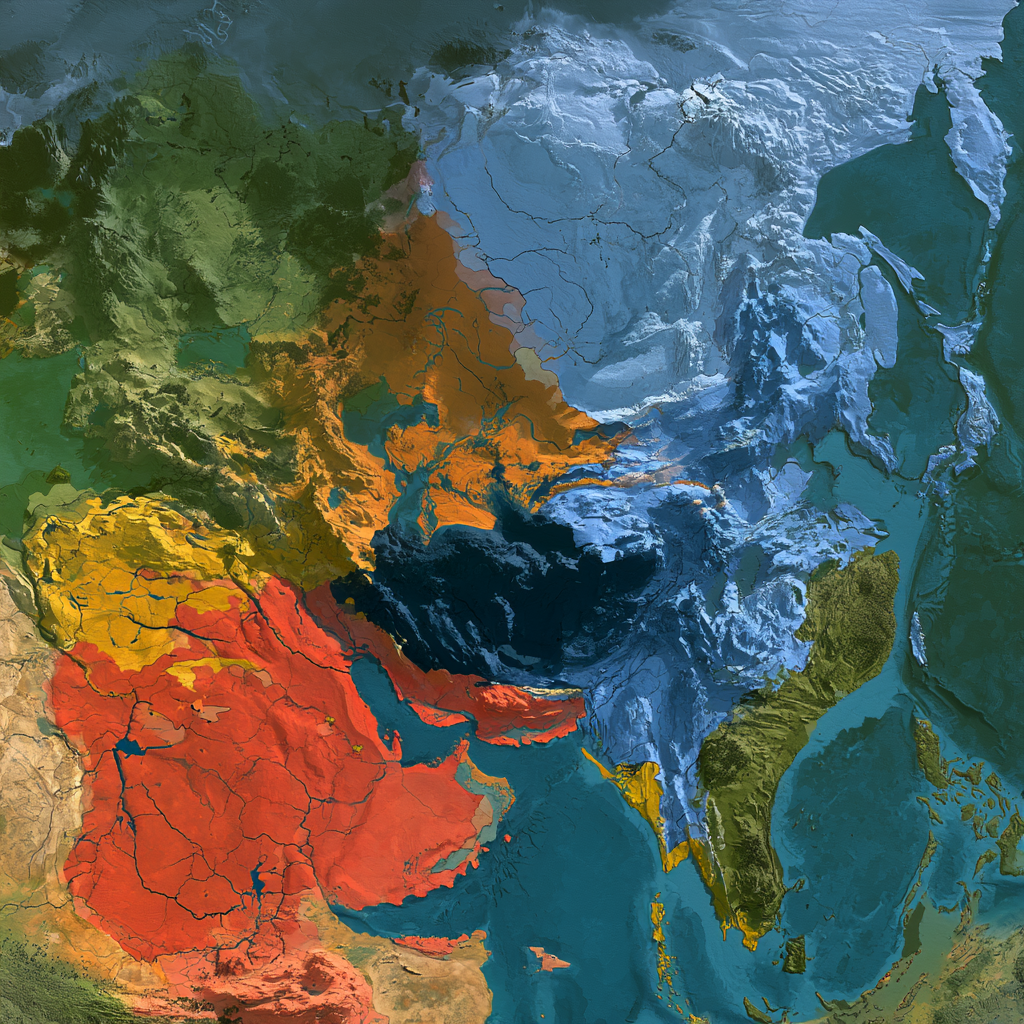
In studying philosophy I sometimes find that it’s easier to think about the varying positions as opposing or rival camps. Here is an ongoing list of the major camps under the different subjects we study in philosophy and where they fall among the varying sides of each debate.

PHILOSOPHY CAMPS
A Giant Outline of Major Philosophical Positions
I. METAPHYSICS
Central question: What ultimately exists, and what is reality fundamentally like?
A. Realism
Realists argue that at least some features of reality exist independently of human minds, language, beliefs, or conceptual schemes.
Examples might include physical objects, properties, mathematical entities, universals, moral facts, or causal relations.
B. Anti-Realism
Anti-realists deny, in some domain, that the things being discussed exist completely independently of minds, conceptual frameworks, linguistic practices, or human responses.
Anti-realism is therefore usually domain-specific rather than one single metaphysical doctrine.
C. Nominalism
Nominalists deny that abstract universals such as redness, humanity, or triangularity exist as independently existing entities.
There are red things, according to many nominalists, but there need not be an additional object called Redness itself.
D. Platonism
Platonists maintain that abstract objects such as numbers, mathematical structures, propositions, or universals exist independently of particular physical objects and minds.
Numbers, for example, aren’t merely marks humans invented.
E. Aristotelian Realism
Aristotelian realists accept universals or real properties but generally hold that they exist in instantiated things, rather than in a separate Platonic realm.
Humanity exists in human beings rather than in an independently existing Form of Humanity.
F. Essentialism
Essentialists hold that at least some things possess essential properties—features they could not lose while remaining the thing they are.
A human being might contingently have brown hair but essentially belong to a certain biological kind.
G. Anti-Essentialism
Anti-essentialists are skeptical that things possess deep, intrinsic essences determining what they fundamentally are.
Categories may instead depend heavily on history, conventions, functions, similarities, or conceptual practices.
Substance and Fundamental Reality
H. Monism
Monists argue that reality is ultimately composed of one fundamental kind of thing or, in stronger versions, one fundamental substance.
I. Materialism / Physicalism
Physicalists argue that fundamentally, everything is physical, or everything ultimately depends upon physical reality.
Mental phenomena, organisms, societies, and so forth must ultimately fit within the physical world.
J. Idealism
Idealists hold that reality is fundamentally mental, experiential, or mind-like rather than fundamentally material.
Some forms claim physical objects are ultimately collections or structures of experiences.
K. Dualism
Dualists hold that reality contains two fundamentally different kinds of things or properties, most famously the mental and the physical.
L. Pluralism
Metaphysical pluralists argue that reality cannot be reduced to one or two fundamental categories.
There may be several irreducible kinds of entities, properties, processes, or structures.
Objects and Composition
M. Mereological Universalism
Universalists argue that any collection of objects has a corresponding composite object.
Your left shoe, Saturn, and a tree therefore compose something, however strange that thing may be.
N. Mereological Nihilism
Mereological nihilists argue that composite objects do not fundamentally exist.
Strictly speaking, there may be particles arranged chair-wise rather than an additional object called the chair.
O. Restricted Composition
This middle position holds that some collections compose objects and others don’t.
The philosophical problem becomes determining when composition occurs.
Persistence Through Time
P. Endurantism
Objects are wholly present at each moment at which they exist.
You today and you yesterday are literally the same persisting object.
Q. Perdurantism
Objects extend through time somewhat as they extend through space.
A person has different temporal parts at different times.
R. Stage Theory
What we ordinarily call a persisting object is actually a series of distinct momentary stages connected by appropriate relations.
Causation
S. Causal Realism
Causal relations are genuine features of reality.
Something more exists than merely event A regularly being followed by event B.
T. Humeanism About Causation
Humean approaches typically resist mysterious necessary connections between events.
Causation may ultimately reduce to patterns, regularities, counterfactual relations, or the overall structure of events.
U. Powers / Dispositionalism
Objects possess genuine causal powers or dispositions.
Fragility, charge, mass, and similar properties involve ways objects are disposed to behave.
II. EPISTEMOLOGY
Central question: What can we know, and what makes a belief justified?
Sources of Knowledge
A. Rationalism
Rationalists emphasize reason as a source of substantive knowledge.
Some truths can be known independently of sensory experience.
B. Empiricism
Empiricists argue that experience is the primary source of substantive knowledge about the world.
Observation and sensory evidence therefore play a foundational role.
C. Intuitionism
Some philosophers hold that rational intuition can provide prima facie justification for certain propositions.
Logical, mathematical, modal, or moral judgments are sometimes explained this way.
Structure of Justification
D. Foundationalism
Some justified beliefs are basic and do not derive their justification from other beliefs.
Other justified beliefs ultimately rest upon these foundations.
E. Coherentism
Beliefs are justified primarily because they belong to a sufficiently coherent web of beliefs rather than because they terminate in privileged foundational beliefs.
F. Infinitism
Justification may require an indefinitely extendable chain of reasons.
The chain neither terminates in foundations nor loops back on itself.
Internalism vs Externalism
G. Epistemic Internalism
The factors determining whether a belief is justified must in some relevant sense be available to the believer’s perspective or reflection.
H. Epistemic Externalism
A belief can be justified or count as knowledge because of factors the believer may not personally recognize.
A reliable perceptual mechanism is a common example.
I. Reliabilism
A belief is justified or knowledgeable when it results from a reliable belief-forming process.
Vision under good conditions may be reliable even if the person cannot prove its reliability.
Knowledge Itself
J. Classical JTB Theory
Traditionally, knowledge was analyzed as:
- Belief
- Truth
- Justification
Gettier cases famously challenged whether these three conditions are sufficient.
K. No-False-Lemmas Views
Knowledge requires justified true belief that does not depend upon relevant false assumptions.
L. Safety Theories
You know something only when your belief could not easily have been false in nearby possible circumstances.
M. Sensitivity Theories
Roughly, if the proposition were false, you would not believe it.
N. Virtue Epistemology
Knowledge results from epistemically competent or intellectually virtuous agency.
True belief must arise because of the believer’s cognitive competence rather than luck.
Skepticism
O. Global Skepticism
Radical skeptics question whether we can know much—or anything—about the external world.
Dreams, simulations, and evil-demon scenarios illustrate the problem.
P. Local Skepticism
Skepticism may instead concern particular domains: morality, religion, memory, other minds, induction, etc.
Q. Pyrrhonian Skepticism
Pyrrhonists emphasize suspension of judgment where equally powerful considerations can be given on opposing sides.
Responses to Skepticism
R. Mooreanism
Some ordinary propositions—such as here is a hand—may be more certain than the skeptical premises used against them.
S. Contextualism
Standards for correctly saying someone knows can vary with conversational context.
T. Pragmatism
Pragmatists emphasize the practical role of inquiry and belief.
Knowledge is connected to successful inquiry, action, prediction, and problem-solving.
III. ETHICS / NORMATIVE ETHICS
Central question: How should we act?
Consequentialism
A. Consequentialism
The moral status of actions ultimately depends upon their consequences.
B. Utilitarianism
We should choose actions that maximize overall utility, welfare, happiness, preference satisfaction, or some related good.
C. Act Utilitarianism
Evaluate each individual act according to whether it produces the best consequences.
D. Rule Utilitarianism
Follow rules whose general acceptance or practice would produce the best consequences.
E. Negative Utilitarianism
Reducing suffering receives priority over increasing happiness.
Deontology
F. Deontology
Some actions are morally required or prohibited independently of whether they maximize good consequences.
G. Kantian Ethics
Rational agents must act according to principles they can rationally universalize and must treat persons as ends rather than merely means.
H. Rights-Based Ethics
Individuals possess moral rights that impose constraints upon what others may permissibly do to them.
Virtue-Based Ethics
I. Virtue Ethics
Ethics should focus primarily on character, virtues, and human flourishing, rather than merely rules or consequences.
The central question becomes not only “What should I do?” but “What kind of person should I become?”
J. Aristotelian Virtue Ethics
Human flourishing involves cultivating excellences of character and practical wisdom.
Virtue often consists in appropriately responding to circumstances rather than mechanically following rules.
K. Stoicism
Virtue is the central good.
We should cultivate rational self-command and distinguish what lies within our control from what does not.
Contract Approaches
L. Contractarianism
Moral rules are justified because rational self-interested agents would agree to them under appropriate bargaining conditions.
M. Contractualism
Morality concerns principles that could not reasonably be rejected by persons seeking mutually justifiable rules.
These theories are related but importantly different from Hobbesian contractarianism.
Other Ethical Frameworks
N. Ethics of Care
Traditional moral theory places too much emphasis on abstract rules and isolated individuals.
Care ethics emphasizes relationships, dependency, vulnerability, empathy, and responsibility.
O. Ethical Egoism
Agents morally ought to pursue their own interests.
P. Altruism
Moral agents have genuine reasons or obligations to promote the welfare of others, sometimes at substantial personal cost.
Q. Particularism
There need not be exceptionless moral principles.
Whether a consideration counts morally for or against an action can depend upon context.
R. Moral Pluralism
Several irreducible moral values may exist.
Justice, liberty, welfare, loyalty, autonomy, and equality may all matter without reducing to one master value.
IV. METAETHICS
Central question: What are moral claims actually claiming, and can they be objectively true?
Cognitivism
A. Moral Cognitivism
Moral statements such as “murder is wrong” express propositions capable of being true or false.
Moral Realism
B. Moral Realism
At least some moral propositions are objectively true and their truth does not merely reduce to personal approval.
C. Robust / Non-Natural Realism
Objective moral facts exist but are not reducible to ordinary natural or scientific properties.
D. Moral Naturalism
Moral facts are objective but ultimately identical with, constituted by, or grounded in natural facts.
E. Cornell Realism
Moral properties are natural higher-level properties somewhat analogous to properties recognized in the special sciences.
Anti-Realism
F. Moral Anti-Realism
There are no stance-independent moral facts of the sort posited by robust moral realists.
But anti-realists disagree strongly about what follows.
G. Error Theory
Ordinary moral claims purport to describe objective moral facts, but those facts do not exist.
Therefore ordinary positive moral claims are systematically false.
H. Noncognitivism
Moral statements do not primarily function as descriptions of moral reality.
I. Emotivism
Moral utterances primarily express attitudes.
“Stealing is wrong” functions roughly like expressing disapproval of stealing.
J. Prescriptivism
Moral language primarily prescribes or commands behavior rather than describing moral properties.
K. Expressivism
Modern expressivists argue that moral statements express practical attitudes, commitments, plans, or norms while explaining why moral discourse nevertheless behaves logically like ordinary factual discourse.
Constructivism
L. Moral Constructivism
Moral truths arise from, or are determined by, some suitable procedure of rational construction.
The truths aren’t simply discovered as independently existing Platonic facts.
M. Kantian Constructivism
Moral principles emerge from requirements implicit in rational agency or rational deliberation.
Relativism and Subjectivism
N. Moral Relativism
Moral truth may vary relative to cultures, frameworks, societies, or standards.
O. Individual Subjectivism
Moral judgments depend upon the attitudes or approvals of individual subjects.
P. Ideal Observer Theory
Moral truth is analyzed in terms of what suitably informed, rational, impartial observers would approve.
Other Metaethical Positions
Q. Moral Nihilism
There are no genuine moral facts, properties, or obligations.
R. Moral Fictionalism
Even if objective moral facts don’t exist, continuing to use moral language may be practically useful.
S. Quietism
Certain grand metaphysical debates about morality may arise from misconceptions about how moral language functions.
V. PHILOSOPHY OF MIND
Central question: What is the mind, and how does consciousness relate to the physical world?
Dualism
A. Substance Dualism
Mind and body are fundamentally different kinds of substance.
The traditional Cartesian soul-body distinction is the paradigm case.
B. Property Dualism
Only one fundamental kind of substance may exist, but mental properties cannot be reduced to physical properties.
C. Epiphenomenalism
Mental events may be produced by physical events while themselves exerting little or no causal influence upon physical events.
Physicalism
D. Identity Theory
Mental states are identical with physical brain states.
Pain, for example, is ultimately some neurological state or process.
E. Functionalism
Mental states are defined primarily by what they do—their causal roles—rather than what material they are made from.
F. Behaviorism
Mental-state talk can be understood largely in terms of observable behavior or behavioral dispositions.
G. Eliminative Materialism
Some familiar folk-psychological categories such as belief or desire may ultimately be replaced by a mature neuroscience.
H. Reductive Physicalism
Mental phenomena are real but reducible in principle to physical facts.
I. Nonreductive Physicalism
Mental phenomena depend entirely upon physical reality but cannot be straightforwardly reduced to lower-level physical descriptions.
Alternative Views
J. Panpsychism
Consciousness or proto-conscious properties are fundamental and widespread features of reality.
K. Russellian Monism
Physics describes the relational or structural features of matter while consciousness may reveal something about matter’s intrinsic nature.
L. Neutral Monism
Mind and matter both derive from some more fundamental reality that is intrinsically neither mental nor physical.
M. Idealism
The mental is fundamental and what we call physical reality is dependent upon it.
Consciousness
N. Representationalism
The phenomenal character of experience is explained substantially through what experience represents.
O. Higher-Order Theories
A mental state becomes conscious when the subject has an appropriate higher-order representation of that state.
P. Global Workspace Theory
Consciousness involves information becoming globally available to multiple cognitive systems.
Q. Illusionism
Our introspective conception of phenomenal consciousness systematically misrepresents what is occurring.
This does not necessarily mean that experiences don’t occur; rather, the controversial phenomenal properties we attribute to them may not exist as we suppose.
VI. FREE WILL AND AGENCY
Central question: Could we genuinely have done otherwise, and are we morally responsible?
Determinism
A. Causal Determinism
Given the complete state of the universe and the laws of nature, only one future is physically possible.
B. Indeterminism
Past conditions and laws do not uniquely determine every future event.
Compatibility Positions
C. Compatibilism
Free will can exist even if determinism is true.
Freedom typically requires appropriate forms of rational control, responsiveness to reasons, or acting according to one’s desires without coercion—not metaphysical indeterminacy.
D. Classical Compatibilism
You act freely when you act according to your desires without external constraint.
E. Reasons-Responsive Compatibilism
Responsibility depends upon possessing mechanisms capable of recognizing and responding appropriately to reasons.
Incompatibilism
F. Libertarian Free Will
Free will exists and determinism is false.
At least some human choices are genuinely open in a metaphysically significant sense.
G. Agent-Causal Libertarianism
Agents themselves can originate actions in a way not reducible to ordinary event causation.
H. Event-Causal Libertarianism
Free choices arise from indeterministic causal processes involving reasons and decisions without requiring a special kind of agent-causation.
Skeptical Positions
I. Hard Determinism
Determinism is true and therefore genuine free will does not exist.
J. Hard Incompatibilism
Whether determinism is true or false, humans lack the kind of ultimate control necessary for traditional desert-based moral responsibility.
K. Free-Will Skepticism
We should be skeptical that humans possess the control required for basic-desert responsibility.
L. Illusionism About Free Will
The ordinary impression that we possess radically self-originating freedom may be psychologically powerful but mistaken.
VII. PHILOSOPHY OF RELIGION
Central questions: Does God exist? What would God be like? Can religious belief be rational?
Positions on God
A. Theism
At least one God exists.
In classical monotheism, God is typically conceived as extraordinarily powerful, knowledgeable, morally perfect, and the creator or foundation of reality.
B. Classical Theism
God is metaphysically ultimate and traditionally described as necessary, timeless or eternal, immaterial, omnipotent, omniscient, and perfectly good.
C. Theistic Personalism
God is understood more straightforwardly as a supreme personal agent possessing immense or maximal attributes.
D. Deism
A creator exists but does not ordinarily intervene miraculously or reveal doctrines through particular religions.
E. Pantheism
God and the totality of reality are, in some important sense, identical.
F. Panentheism
Everything exists in God, but God is more than the universe.
G. Polytheism
Multiple gods exist.
H. Atheism
No gods exist, or at minimum the propositions asserting particular gods exist are false.
I. Agnosticism
One does not know whether God exists, or the evidence is insufficient to justify either belief or disbelief.
J. Ignosticism
Before asking whether God exists, the concept of God must be made sufficiently coherent and meaningful.
K. Religious Naturalism
Religious or spiritual attitudes may be maintained without positing supernatural entities.
Arguments Concerning God
L. Cosmological Approaches
The existence, contingency, beginning, causal structure, or intelligibility of reality is argued to require some ultimate explanation.
M. Fine-Tuning Arguments
Certain physical conditions appear unusually suited for complex life, which some take as evidence favoring design.
N. Teleological Arguments
Order, complexity, purpose-like structure, or apparent design is used to infer intelligence.
O. Ontological Arguments
The existence of God is argued from the concept or modal status of a maximally great or necessary being.
P. Moral Arguments
Objective moral facts or obligations are claimed to require, support, or be better explained by God.
Q. Religious Experience Arguments
Religious experiences are treated as prima facie evidence of transcendent reality.
Arguments Against Theism
R. Problem of Evil
The amount, kinds, or distribution of suffering appear difficult to reconcile with an omnipotent, omniscient, perfectly good God.
S. Divine Hiddenness
A perfectly loving God might be expected to make divine reality accessible to all sincere nonresistant seekers.
Yet apparently sincere nonbelief exists.
T. Incoherence Arguments
Certain combinations of traditional divine attributes may allegedly generate contradictions or conceptual problems.
U. Naturalistic Explanations of Religion
Religious belief may be sufficiently explained by psychology, sociology, evolution, cultural transmission, and cognitive science without invoking divine reality.
VIII. POLITICAL PHILOSOPHY
Central question: How should society organize power, rights, property, and institutions?
A. Liberalism
Political institutions should strongly protect individual liberty, rights, equality before the law, and personal autonomy.
B. Classical Liberalism
Emphasizes individual liberty, private property, limited government, markets, and legal equality.
C. Social Liberalism
Combines civil liberties with a significant governmental role in providing social protections and addressing inequality.
D. Conservatism
Places substantial value on inherited institutions, social stability, tradition, gradual reform, and skepticism toward sweeping political reconstruction.
E. Libertarianism
Individual liberty and strong property rights place severe constraints upon permissible government coercion.
F. Right-Libertarianism
Strong private property rights and market exchange receive particular emphasis.
G. Left-Libertarianism
Self-ownership may be combined with egalitarian claims regarding natural resources or social wealth.
H. Anarchism
Political authority requires justification and perhaps cannot ultimately be justified.
Different anarchists disagree radically over property and economic organization.
I. Anarcho-Capitalism
Government should be replaced by voluntary arrangements, private property, markets, and privately provided legal/security institutions.
J. Social Anarchism
Opposes coercive state authority while also rejecting hierarchical capitalist property relations.
K. Socialism
Important economic resources should be subject to social, worker, public, or democratic control rather than predominantly private capitalist ownership.
L. Marxism
Historical and political structures are profoundly shaped by class relations and modes of production, with capitalism containing internal tensions that may give rise to systemic transformation.
M. Communism
In its theoretical endpoint, productive resources are commonly held and class divisions—and eventually coercive state structures—disappear.
N. Social Democracy
Markets and private ownership remain, but are combined with extensive social insurance, regulation, redistribution, and labor protections.
O. Republicanism
Political freedom is often understood as non-domination: not being subject to another person’s arbitrary power.
P. Communitarianism
Political theories focused only on autonomous individuals neglect the importance of community, social identity, traditions, and shared practices.
Q. Rawlsian Egalitarianism
Just institutions are those rational persons would select under appropriately fair conditions, famously represented by Rawls’s original position and veil of ignorance.
R. Nozickian Entitlement Theory
Justice depends primarily upon how holdings were acquired and transferred rather than upon achieving a particular distributive pattern.
S. Egalitarianism
Political institutions should substantially reduce unjustified inequalities.
T. Prioritarianism
Benefits matter morally more when they go to people who are worse off.
U. Sufficiency Views
The crucial requirement may be ensuring everyone possesses enough, rather than making outcomes strictly equal.
IX. LANGUAGE, MEANING, LOGIC & TRUTH
Central questions: What makes language meaningful? What is truth? How does language relate to reality?
Theories of Truth
A. Correspondence Theory
A proposition is true when it corresponds appropriately to reality or the facts.
B. Coherence Theory
Truth is closely connected with belonging to a coherent system of propositions or beliefs.
C. Pragmatic Theory
Truth is tied to successful inquiry, warranted assertibility, practical consequences, or the eventual convergence of ideal inquiry.
D. Deflationism
Calling a statement “true” adds little metaphysical substance.
“To say that snow is white is true” amounts roughly to saying snow is white.
E. Minimalism
Truth is a legitimate property, but a very thin one requiring no deep metaphysical correspondence relation.
Meaning
F. Referentialism
Words derive meaning substantially from the objects or entities they refer to.
G. Descriptivism
Some expressions refer through associated descriptions or descriptive content.
H. Causal-Historical Theories
Names and natural-kind terms can refer through historical chains of communication linking speakers to the original referent.
I. Use Theory
The meaning of a word is intimately connected with how it functions within linguistic practices.
Associated especially with later Wittgenstein.
J. Inferentialism
Meaning is determined substantially by the inferential role an expression plays within reasoning.
Philosophical Traditions Concerning Language
K. Ordinary Language Philosophy
Many philosophical problems arise because words are removed from their ordinary contexts of use.
Careful attention to ordinary usage can dissolve philosophical confusion.
L. Logical Atomism
Complex propositions and reality may be analyzable into simpler logical components.
M. Logical Positivism
Meaningful factual claims should in some important way connect with empirical verification, while logic and mathematics operate differently.
Strong early verificationist versions encountered serious problems.
N. Formal Semantics
Natural-language meaning can be systematically represented using formal tools derived from logic, mathematics, and model theory.
Logic
O. Classical Logic
Typically accepts principles such as excluded middle and noncontradiction in their classical forms.
P. Intuitionistic Logic
Rejects unrestricted use of excluded middle and connects truth more closely with constructive proof.
Q. Paraconsistent Logic
Some contradictions can be tolerated without allowing everything whatsoever to follow.
R. Dialetheism
Some contradictions are actually true.
S. Modal Logic
Formalizes notions such as necessity and possibility.
X. CONTINENTAL PHILOSOPHY
This label describes a broad family of traditions rather than one doctrine.
Phenomenology
A. Phenomenology
Philosophers investigate the structures of conscious experience as they appear from the first-person perspective.
B. Husserlian Phenomenology
Attempts to carefully describe the structures of intentional consciousness while suspending certain assumptions about the external world.
C. Existential Phenomenology
Thinkers such as Heidegger, Sartre, and Merleau-Ponty emphasize embodied, situated existence rather than consciousness understood merely as an abstract spectator.
Existentialism
D. Existentialism
Human existence involves questions of freedom, meaning, anxiety, responsibility, authenticity, and mortality.
E. Sartrean Existentialism
Human beings lack a predetermined essence and continually define themselves through choices.
F. Absurdism
Humans seek meaning and intelligibility while confronting a universe that may provide no ultimate answer to that demand.
Camus is strongly associated with this tradition.
Hermeneutics
G. Hermeneutics
Understanding is fundamentally interpretive.
Interpretation applies not merely to texts but potentially to history, culture, human action, and existence itself.
Structuralism
H. Structuralism
Human phenomena can often be understood by discovering the underlying systems and relational structures that organize them.
Language, myth, culture, and social practices exhibit structures individuals may not consciously recognize.
Post-Structuralism
I. Post-Structuralism
Challenges the idea that stable, universal structures completely determine language, identity, culture, or meaning.
Meaning and social organization are often more unstable, historical, and contested than classical structuralists suggested.
Deconstruction
J. Deconstruction
Associated especially with Derrida.
Texts and conceptual systems often depend upon oppositions and assumptions that destabilize the simple meanings they appear to establish.
Deconstruction is not simply the claim that words mean anything whatsoever.
Critical Theory
K. Critical Theory
Social philosophy should not merely describe society but investigate and criticize structures of domination, ideology, alienation, and power.
L. Frankfurt School
Thinkers such as Horkheimer, Adorno, Marcuse, and later Habermas analyze capitalism, bureaucracy, mass culture, rationalization, and domination.
M. Habermasian Critical Theory
Emphasizes communicative rationality, democratic deliberation, and conditions under which discourse can occur without domination.
Genealogy
N. Genealogical Approaches
Concepts and values are investigated historically to uncover how apparently natural or inevitable categories emerged.
Nietzsche and Foucault are major influences.
O. Foucauldian Analysis
Knowledge, institutions, classification, and power interact in ways that shape subjects and social possibilities.
XI. PHILOSOPHY OF SCIENCE
This one wasn’t given a separate kingdom on the image, but it absolutely deserves one if you expand the map.
Central question: What makes science successful, rational, explanatory, and distinctive?
A. Scientific Realism
Our best scientific theories are at least approximately true, including claims about unobservable entities such as electrons or genes.
B. Instrumentalism
Scientific theories need not literally describe hidden reality; their primary virtue may be successful prediction and organization of observations.
C. Constructive Empiricism
Science aims at empirical adequacy, not necessarily truth about unobservable entities.
D. Falsificationism
Scientific theories should expose themselves to possible falsification through observation.
Associated especially with Karl Popper.
E. Kuhnian Paradigm Theory
Scientific communities operate within paradigms that shape legitimate problems, methods, concepts, and standards.
Scientific revolutions may involve major shifts between paradigms.
F. Scientific Pluralism
Different models or theoretical frameworks may legitimately explain different aspects of the same phenomenon.
G. Reductionism
Higher-level scientific phenomena can ultimately be reduced to lower-level physical explanations.
H. Emergentism
Higher-level systems may possess patterns or properties that cannot be adequately explained merely by describing their lowest-level components.
XII. PHILOSOPHY OF MATHEMATICS
Another territory worth adding.
A. Mathematical Platonism
Mathematical objects exist objectively and independently of human minds.
B. Nominalism
There are no abstract mathematical objects.
C. Formalism
Mathematics concerns manipulation of formal symbol systems according to rules.
D. Logicism
Mathematics can in some important sense be grounded in or reduced to logic.
E. Intuitionism
Mathematical truth depends upon constructive mathematical proof rather than an independently existing completed mathematical realm.
F. Structuralism
Mathematics concerns structures and positions within structures rather than independently individuated mathematical objects.
XIII. PHILOSOPHY OF TIME
This could become another highly visual “nation.”
A. Presentism
Only the present exists.
The past no longer exists, and the future does not yet exist.
B. Eternalism
Past, present, and future events are equally real.
C. Growing Block Theory
The past and present exist, but the future does not yet exist.
Reality continually “grows.”
D. A-Theory
There is an objective distinction between past, present, and future.
E. B-Theory
Temporal reality fundamentally consists of relations such as earlier than and later than, without an objectively privileged moving present.
XIV. PERSONAL IDENTITY
Central question: What makes you the same person through time?
A. Biological Continuity
Personal identity consists fundamentally in continuity of the living human organism.
B. Psychological Continuity
Identity depends upon appropriately connected memories, intentions, personality, consciousness, and other psychological relations.
C. Soul Theory
Personal identity consists in persistence of a nonphysical soul or subject.
D. Bundle Theory
There may be no deep persisting self beyond a changing collection of perceptions, memories, dispositions, and psychological states.
E. Reductionism
Personal identity may consist entirely in more basic physical or psychological relations rather than an additional metaphysical fact.
Parfit famously develops a view in this general neighborhood.
XV. AESTHETICS
Central questions: What is beauty? What is art? Are aesthetic judgments objective?
A. Aesthetic Realism
At least some aesthetic claims are objectively true.
B. Aesthetic Subjectivism
Beauty and aesthetic value depend fundamentally upon subjects’ responses.
C. Formalism
Aesthetic value depends heavily upon structural features such as form, composition, harmony, rhythm, or arrangement.
D. Expressionism
Artistic significance arises substantially from the expression of emotion, attitude, or experience.
E. Institutional Theory of Art
Something counts as art partly because of its relation to the practices and institutions of the artworld.
XVI. THE REALLY BIG CROSS-BORDER WARS
These are especially good for the map because they cut across multiple philosophical nations.
1. Realism vs Anti-Realism
Realists: reality in some domain exists independently of what we think about it.
Anti-realists: truth or existence in that domain depends in some important way upon minds, practices, schemes, responses, or language.
2. Naturalism vs Supernaturalism
Naturalists: reality is exhausted by the natural world, broadly understood.
Supernaturalists: reality contains entities, powers, minds, or domains not reducible to the natural world.
3. Physicalism vs Dualism
Physicalists: everything ultimately fits within physical reality.
Dualists: mentality possesses some fundamentally nonphysical aspect.
4. Determinism vs Libertarianism
Determinists: earlier states plus laws fix what happens next.
Libertarians: at least some free human decisions are not deterministically fixed.
5. Consequentialism vs Deontology
Consequentialists: outcomes ultimately determine rightness.
Deontologists: some duties or constraints apply regardless of maximizing outcomes.
6. Moral Realism vs Moral Anti-Realism
Realists: objective moral truths exist.
Anti-realists: morality does not involve stance-independent facts of that kind.
7. Rationalism vs Empiricism
Rationalists: reason can provide substantial knowledge independently of experience.
Empiricists: substantive knowledge is fundamentally grounded in experience.
8. Foundationalism vs Coherentism
Foundationalists: justification ultimately rests on basic beliefs.
Coherentists: justification arises from relations within an interconnected system of beliefs.
9. Essentialism vs Anti-Essentialism
Essentialists: things can possess necessary features constituting what they are.
Anti-essentialists: many alleged essences reflect contingent classifications, practices, or histories.
10. Reductionism vs Emergentism
Reductionists: higher-level phenomena ultimately reduce to more fundamental constituents.
Emergentists: organization can produce genuinely significant higher-level properties or patterns not captured adequately at the lower level alone.
11. Individualism vs Collectivism
Individualists: individual persons are the primary units of political or moral analysis.
Collectivists: communities, classes, cultures, or social structures may possess interests or explanatory priority that cannot simply be reduced to isolated individuals.
12. Absolutism vs Relativism
Absolutists: at least some truths, values, or standards hold universally.
Relativists: truth or correctness in the relevant domain depends upon frameworks, cultures, perspectives, or standards.